Foreshock Analytical Module:
Understanding Foreshocks and Their Relationship to Mainshocks
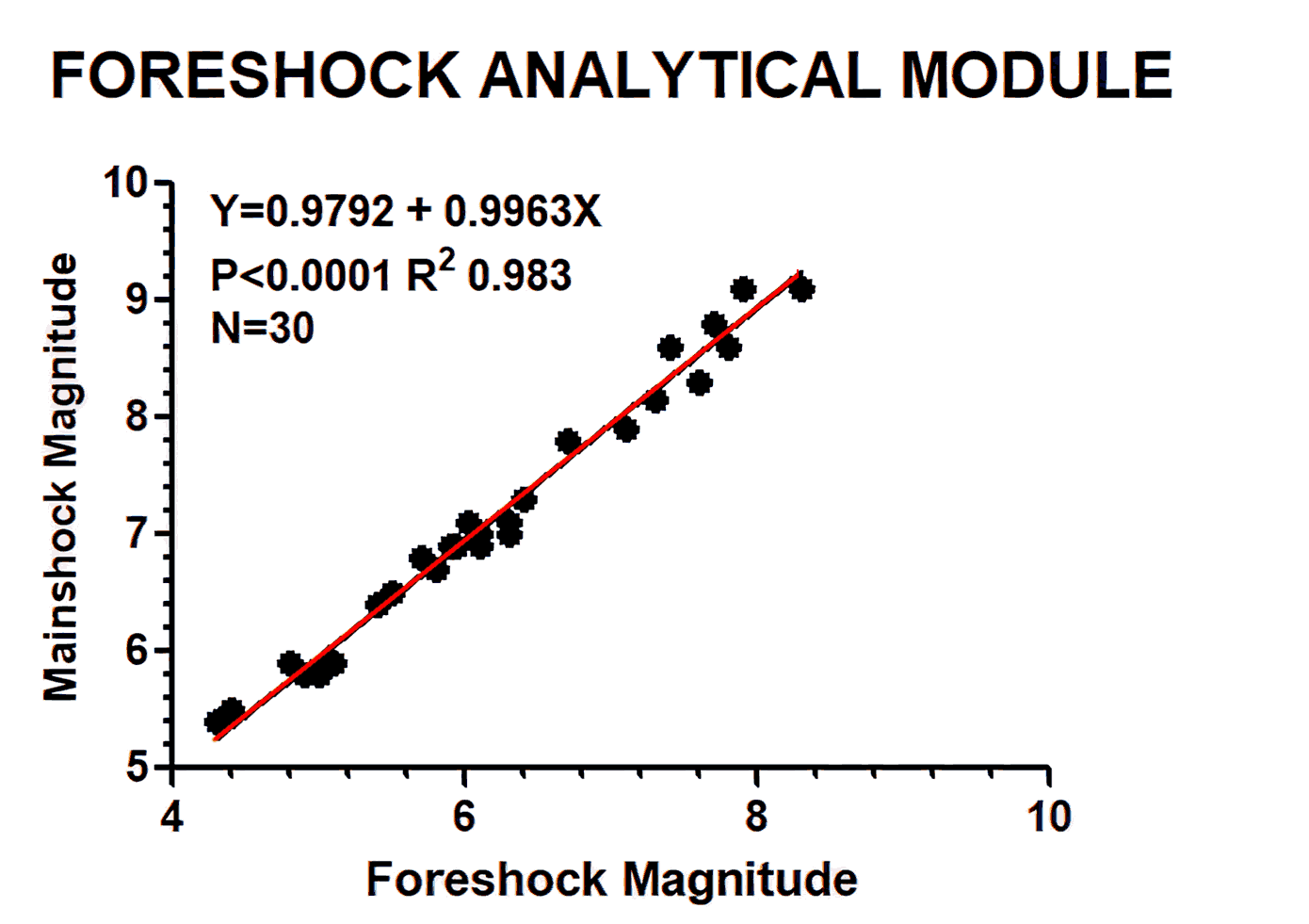
Figure 1. This module gives the linear correlation and equation for the relationship between mainshocks and their ecologically defined peak foreshocks. This analysis supports the hypothesis that across their entire range, mainshocks can be expected, on average, to be about one magnitude greater than their corresponding foreshock.
Defining Foreshocks
According to the official stance, a foreshock cannot be classified as such until after the mainshock has occurred. The US Geological Survey (USGS) notes that foreshocks are earthquakes which precede larger earthquakes in the same location, but an earthquake cannot be identified as a foreshock until a larger event occurs in the same area. Foreshocks, aftershocks - what’s the difference? | US Geological Survey.
An alternative perspective, outlined in the new ecological theory, suggests a broader approach to identifying foreshocks. This theory focuses on the regional dynamics of earthquakes. Here, the primary foreshock is typically considered the largest regional seismic event, roughly one magnitude less than the anticipated mainshock (as calculated using the Mainshock Analytical Module). These foreshocks generally occur as a “peak” or upswing in annual seismic activity, followed by a decline in events leading up to the mainshock. This approach allows for the possibility of recognising foreshocks several years in advance.
Fig.1 (Tonga) demonstrates that, at the end of 2022, the Mainshock Analytical Module was already forecasting a magnitude 7.85 mainshock. By the end of 2024, forecasts projected a magnitude 8.0-8.1 mainshock. The annual event sequence reveals a typical “foreshock peak” at magnitude 7.3 in 2022, and a magnitude 7.0 foreshock in 2025, following the new ecological theory.
It is important to note that there are instances where large earthquakes occur without any apparent foreshock in the preceding years. Conversely, some foreshocks matching the expected magnitude appear only days or hours before the mainshock. These anomalies highlight the need for further research to better understand their causes.
Foreshock Analytical Module
The Foreshock Analytical Module (see Figure 1, above) reveals a predictive correlation between foreshock and mainshock magnitudes across 30 arbitrarily selected global events. These events were chosen to represent nearly the entire magnitude range.
Analysis from Figure 1 supports the hypothesis that, on average, mainshocks are about one magnitude larger than their corresponding foreshocks. This suggests that a foreshock peak, one magnitude lower than the anticipated mainshock, should be observable. The expected mainshock magnitude can be forecasted in advance using the equation provided by the Mainshock Module.
The “One-tenth Rule” Relating Different Magnitudes
During 2024 the author began searching the USGS earthquake database to study the relative abundance of different magnitudes occurring worldwide each year, and from this he found that numbers tended to follow this posited “One-tenth Rule”:
For each higher magnitude level, the observed annual numbers are about one-tenth the previous level.
Thus, if there are 10,000 magnitude 4.0-4.99 events, then expect approximately 1000 magnitude 5.0-5.99 earthquakes, with the caveat that this only applies to large regions and periods.